

The controversy exposes how misleading livestreams can exploit poverty, distort geographical identities and shape international perceptions through digital platforms.
Key Highlights
- A Prothom Alo investigation identified Chinese livestreamers filming in Dhaka’s Uttara and Tekpara neighbourhoods while allegedly presenting the locations as New Delhi.
- One streamer reportedly described local homes as unhygienic, while another made derogatory claims about tea sold at a roadside stall.
- The investigation reported that more than 150 Chinese nationals had been involved in filming activities in the area; the exact scale remains independently unverified.
- Some livestreamers reportedly used local guides and broadcast through Chinese platforms, including Douyin and WeChat.
- India’s Ministry of External Affairs condemned the misleading portrayal and urged the authorities concerned to take action.
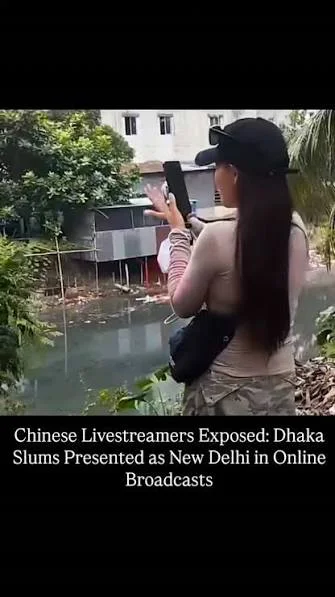
Dhaka’s Streets, New Delhi’s Identity
A narrow lane, modest houses, roadside tea stalls and residents going about their daily routines became the centre of an unusual international controversy after Chinese content creators were accused of presenting neighbourhoods in Dhaka as parts of New Delhi.
The controversy came to light following an investigation by Bangladeshi newspaper Prothom Alo, which reported that Chinese nationals had been filming in low-income localities of Uttara and Tekpara in Dhaka. The footage was reportedly livestreamed on Chinese digital platforms, with the locations being identified to viewers as areas in India's capital.
The accompanying commentary made the episode more disturbing. Some streamers allegedly described the houses as dirty and unhygienic, while one reportedly claimed that tea consumed by local residents was made from cow urine and dirty river water.
The issue is not simply about offensive remarks or misleading travel videos. It concerns the deliberate misrepresentation of geographical locations, the commercial use of poverty-focused content and the possibility that distorted footage could influence how foreign audiences perceive another country.
What Did the Prothom Alo Investigation Find?
The investigation, published on November 6, identified Chinese livestreamers operating in the narrow lanes of Uttara and Tekpara. Journalists visited the neighbourhoods and attempted to speak with several individuals involved in the filming.
One Chinese woman, identified as Mianmian, who introduced herself as being from China's Sichuan province, was reportedly livestreaming beside a canal in Uttara's Sector 12 on November 1. She allegedly presented the location as New Delhi and made disparaging comments about the condition of local homes, sanitation and law and order.
In another instance, a Chinese national identified as Wang Wei was reportedly seen filming at a roadside tea stall in Tekpara. He allegedly told viewers that the tea being consumed by local residents was made using cow urine and dirty river water.
The translations of the Chinese-language broadcasts were reportedly produced using Google Translate and cross-checked with four Bangladeshis familiar with the language. The translations were published by Prothom Alo and subsequently cited by Indian media. NDTV clarified that the translated commentary and its context had not been independently verified by its newsroom.
The investigation also reported that some streamers carried two mobile phones, apparently using one for broadcasting and another to read or display information.
The reported involvement of more than 150 Chinese nationals attracted particular attention. However, this figure should be treated as an estimate reported by the Bangladeshi investigation rather than an independently established count of participants in a coordinated operation.
Who Was Behind the Livestreams and Why Were They Filming?
The motive behind the broadcasts remains one of the most important unanswered questions.
According to Prothom Alo, some Chinese nationals were assisted by local Bangladeshi guides. A woman identified as Ritu Akhter told the newspaper that she had been helping Chinese visitors navigate the neighbourhoods for several months and was being paid between Tk 700 and Tk 800 a day.
She reportedly said that the streamers earned money through videos and livestreams uploaded on platforms such as WeChat and Douyin, the Chinese version of TikTok.
A Chinese national identified as Fangyou reportedly told journalists that the livestreams were connected to product-promotion activities. However, he did not explain why low-income neighbourhoods had been selected or clarify the specific commercial arrangements.
This explanation raises further questions. If the broadcasts were primarily promotional, why were locations repeatedly presented as parts of New Delhi? What products were being promoted, who commissioned the content and how were the streamers being paid?
The available reporting has not established who funded the activity, whether the individuals were working independently or under a common arrangement, or whether the broadcasts had a political objective.
An earlier report by Dhaka-based publication The Business Standard in May had also documented Chinese vloggers filming in low-income neighbourhoods. This suggests that the activity may have been taking place before the November controversy became widely known.
The commercial explanation, therefore, cannot be dismissed, but neither does it resolve the questions surrounding the repeated misrepresentation of locations and the derogatory commentary.
Why Is This Being Viewed as a Disinformation Concern?
Disinformation involves the deliberate creation or circulation of false or manipulated information to mislead an audience. It can be used to influence public opinion, damage reputations, deepen social divisions or weaken trust between communities and countries.
The Dhaka livestream controversy has raised concerns because the footage was allegedly presented with a false geographical identity. Locations in Bangladesh were described as parts of India's capital, while negative comments about housing, sanitation and everyday life were attributed to Indian surroundings.
This changes the meaning of the footage. A viewer watching the livestream without independent knowledge of Dhaka may reasonably assume that the images represent Delhi. The location claim becomes particularly consequential when it is accompanied by commentary intended to portray the country negatively.
However, the term 'disinformation campaign' requires careful use. The reported activity may involve misleading content and repeated patterns of misrepresentation, but the available investigation has not conclusively established a central command structure, political sponsorship or Chinese government involvement.
A coordinated anti-India operation cannot be declared proven merely because several Chinese nationals were involved. Establishing that would require evidence about funding, instructions, common organisers, intended audiences and the purpose of the broadcasts.
The distinction matters. Misleading digital content should be investigated, but conclusions about state-sponsored activity must be supported by verifiable evidence.
India’s Response: MEA Calls for Action
The issue acquired diplomatic significance after India's Ministry of External Affairs responded to questions about the reported livestreams.
MEA spokesperson Randhir Jaiswal said that efforts to present a distorted picture of any country were unfortunate. Referring to the alleged use of Bangladeshi locations to portray Delhi, he criticised the promotion of false narratives and said that such actions undermined the credibility of those involved and those behind them.
India urged the authorities concerned to take appropriate action against the individuals involved.
The response reflected New Delhi's concern over the use of foreign territory and digital platforms to circulate misleading portrayals of India. It also placed responsibility on the relevant authorities to examine the activity rather than allowing the issue to remain limited to social media criticism.
When asked whether India had held formal discussions with China on the matter, Jaiswal did not provide a direct confirmation. He reiterated that the reported activity was unfortunate and that the authorities concerned should act.
The diplomatic response also carries a wider message: digital content that crosses national borders can have consequences beyond the platforms on which it is first published.
Residents’ Privacy and Consent Under Question
While the alleged misrepresentation attracted international attention, the experiences of Dhaka residents raised another serious concern: the right to privacy.
According to the Prothom Alo investigation, some livestreamers allegedly entered residential premises and recorded people without obtaining permission. Residents complained that filming was not restricted to public streets and shops, with some alleging that private areas of their homes had also been recorded.
One resident, Rozina Khatun, reportedly described the discomfort caused when strangers entered homes and began filming. Another resident, Papia Begum, alleged that some streamers had even entered bathrooms while recording.
These accounts, if established, raise questions about consent, dignity and the responsibilities of foreign content creators operating in local communities.
The ability to livestream from a public street does not grant unrestricted permission to record people inside their homes. Nor does the commercial purpose of a video remove the responsibility to respect residents' privacy.
Local authorities must examine such complaints under applicable laws and ensure that residents are not exposed to intrusive filming or unauthorised commercial use of their images.
The issue also highlights the vulnerability of low-income communities, which may be selected for sensational content precisely because residents have fewer resources to challenge or monitor how their images are circulated.
The Business of Poverty-Focused Content
The controversy also draws attention to a wider digital-media trend: the monetisation of poverty.
Images of informal settlements, overcrowded housing, inadequate sanitation and difficult living conditions have long attracted international attention. Such footage can be used for documentary reporting, development research and public-interest journalism. However, it can also be packaged as sensational entertainment to attract views, engagement and commercial returns.
The problem begins when selected images are presented as representative of an entire country or when the identity of a location is deliberately changed.
India, like Bangladesh and several other developing countries, has significant differences in income, housing, infrastructure and access to public services across regions. A single neighbourhood cannot be used as an accurate representation of an entire city, much less a nation.
When footage from Dhaka is presented as Delhi, the issue goes beyond selective representation. It creates a false setting for the commentary and potentially encourages audiences to form opinions based on fabricated geographical claims.
The reported product-promotion explanation also points to the financial incentives that can shape online content. Livestreaming can generate commercial opportunities through advertising, product placement, platform engagement and audience-driven rewards. These incentives may encourage creators to use sensational claims, provocative language and misleading settings to attract attention.
The challenge for regulators and platforms is to distinguish legitimate content creation from deceptive practices without restricting genuine journalism or lawful expression.
How Digital Platforms Can Amplify Misleading Narratives
Digital platforms have changed how international audiences receive information. A livestream can reach viewers in another country instantly, often without the editorial checks applied by established news organisations.
Short videos and livestreams also tend to circulate without their original context. A clip may be downloaded, translated, edited and reposted by different accounts. Once separated from its original location and source, it becomes harder for viewers to establish where it was recorded and what was actually said.
In this case, the alleged use of Dhaka footage as Delhi scenes illustrates how a false location claim can shape the interpretation of otherwise ordinary images.
Platforms such as Douyin and WeChat operate within China's digital ecosystem, while clips and discussions can also travel across international social media networks. Effective moderation therefore requires more than removing individual videos after they become controversial.
Platforms need accessible reporting mechanisms for deceptive location claims, impersonation and privacy violations. Where content is found to be misleading, appropriate labels, removal measures or account-level action may be warranted under platform policies and applicable law.
Media organisations also have a responsibility to verify location, date and context before reproducing viral footage. Sensational claims should not be amplified merely because they attract attention.
What Does the Controversy Mean for India-Bangladesh Relations?
The episode has emerged against the backdrop of a complex India-Bangladesh relationship, shaped by trade, connectivity, border management, security cooperation and regional geopolitics.
Misrepresenting Bangladeshi neighbourhoods as Indian locations risks creating confusion among audiences in both countries. Derogatory commentary attached to the footage may also encourage hostility and reinforce stereotypes.
At the same time, the actions of individual content creators should not be treated as representative of Chinese citizens as a whole, just as the incident should not be used to generalise about Bangladesh or its people.
Dhaka has an interest in examining the complaints of its residents, establishing the nature of the filming activities and ensuring that foreign nationals comply with local laws. India, meanwhile, can address misleading portrayals through diplomatic communication, fact-based public responses and cooperation with relevant authorities.
The incident should not be allowed to become a source of unnecessary hostility between India and Bangladesh. Both countries have an interest in preventing their territories and communities from being used in deceptive content operations.
What Needs to Be Established Next?
The controversy has exposed several gaps that require investigation. The identity of the organisers, the source of funding, the intended audience and the commercial arrangements behind the livestreams remain unclear.
Authorities in Bangladesh need to examine residents' complaints about unauthorised filming and determine whether the activities complied with local regulations. The role of local guides and any payments made to them also deserves scrutiny.
Digital platforms should be asked to examine the broadcasts, identify accounts involved in repeated misleading location claims and assess whether their policies were violated. Where evidence of coordinated manipulation is found, the relevant details should be made available to competent authorities.
For India, the response should be built around verifiable evidence. If a wider organised operation is established, its organisers and funding arrangements should be identified. Until then, allegations of state sponsorship or a centrally directed campaign should remain clearly distinguished from the documented acts of individual streamers.
A False Location Can Create a False National Image
The Dhaka-Delhi controversy demonstrates how digital content can be manipulated without sophisticated technology. A camera, a livestream and a misleading location description can be enough to present one country's neighbourhood as another country's capital.
The alleged use of poverty-focused footage to portray India negatively raises concerns about commercial exploitation, digital disinformation and the protection of residents' privacy. It also shows why the credibility of online information can no longer be taken for granted.
The immediate priority should be to establish who organised the broadcasts, why the locations were misrepresented and whether residents' rights were violated. A fact-based investigation, responsible platform action and diplomatic engagement will be more effective than speculation.
In the digital age, a country's image can be distorted in minutes. Protecting it requires not only a strong official response, but also credible evidence, independent journalism and informed audiences.
Share this Perspective
Spread rigorous policy evaluation across your professional networks.