
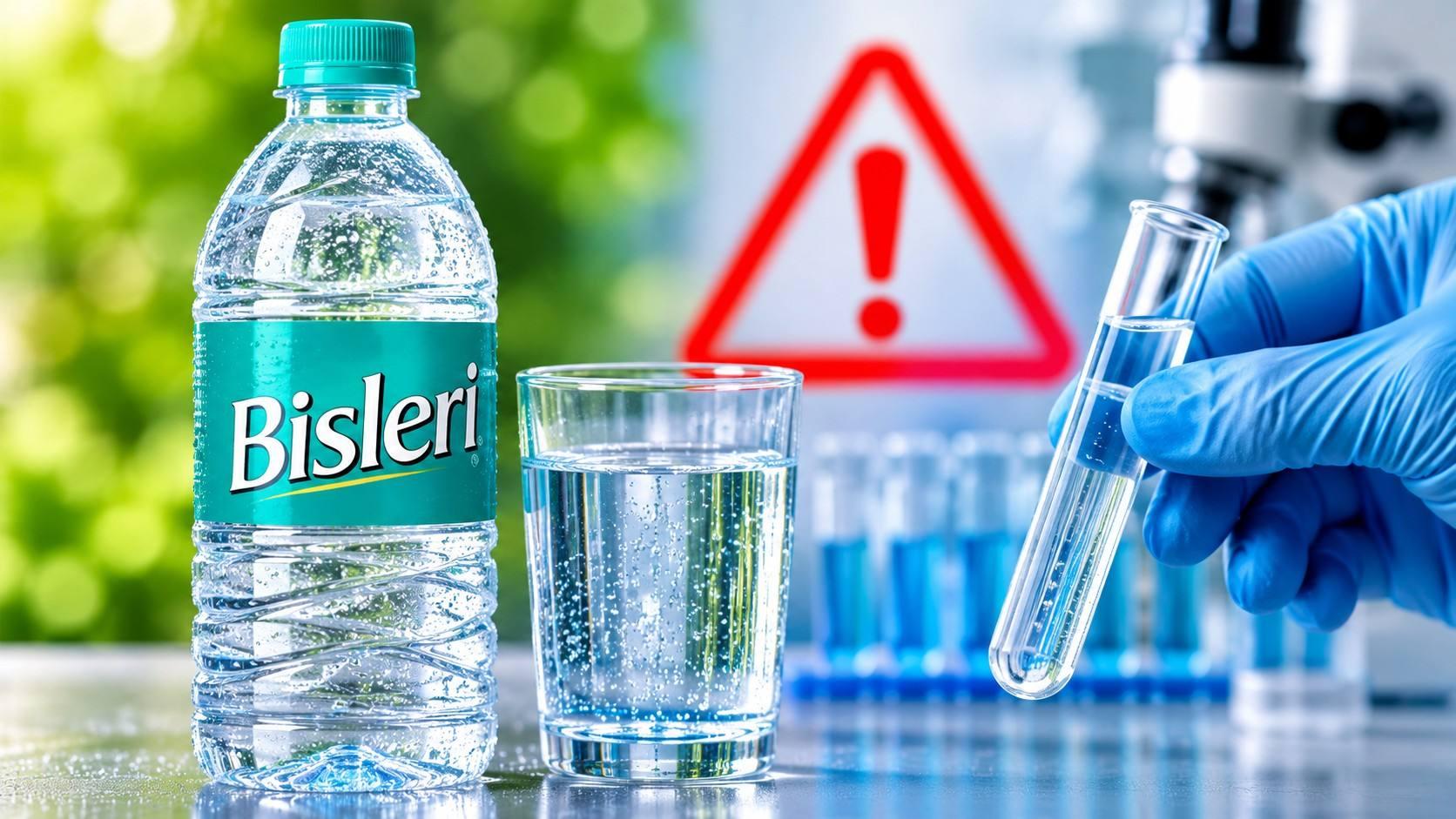
The Bisleri water scare has renewed questions about chemical contamination, consumer safety and the effectiveness of India's packaged drinking water regulations.
Key highlights
- FSSAI action: Prosecution proceedings were sanctioned after a packaged drinking water sample linked to Bisleri was declared unsafe.
- Chemicals detected: Bromate was flagged in the initial laboratory examination, while PAHs were reported in the subsequent referral test.
- Health concerns: Certain levels of exposure to these chemicals may carry long-term health risks, including potential cancer risks.
- Company's response: Bisleri has disputed the findings, stating that its independent testing found bromate within permissible limits.
- Wider implications: The case has renewed scrutiny of packaged drinking water testing, manufacturing controls and regulatory enforcement in India.
For millions of Indians, buying a sealed bottle of drinking water is an everyday decision built on trust. At railway stations, airports, restaurants and neighbourhood shops, familiar brands are often chosen because consumers expect them to meet basic safety standards. That confidence has come under scrutiny after the Food Safety and Standards Authority of India (FSSAI) sanctioned prosecution proceedings against Bisleri International over a packaged drinking water sample declared unsafe in laboratory examinations.
The case has drawn attention to two chemical contaminants: bromate and polynuclear aromatic hydrocarbons (PAHs). Both have been associated with potential health risks, although their toxicity, classification and effects differ. The findings have also raised wider questions about chemical contamination in packaged drinking water, the reliability of testing procedures and the safeguards available to consumers.
However, the regulatory action relates to a specific sample collected from Bisleri's Goa manufacturing facility. It does not establish that every bottle or batch sold under the brand is contaminated.

What did FSSAI find in the Bisleri water sample?
According to the regulatory findings, a sample of packaged drinking water, categorised as water other than natural mineral water, was collected from Bisleri International's premises for laboratory examination.
The initial laboratory test found that the sample did not comply with the prescribed bromate limit and was declared unsafe under the Food Safety and Standards Act, 2006. Following an appeal by the company, the sample was examined by a referral food laboratory. The second examination also classified it as unsafe after PAHs were detected.
Based on these findings, FSSAI sanctioned prosecution proceedings against Bisleri International.
The company, however, has disputed aspects of the findings. In its statement, Bisleri said six samples had been collected from its Goa facility on September 30, 2025. Five were found to meet the applicable standards during initial testing, while the sixth recorded bromate at 12 micrograms per litre against the prescribed limit of 10 micrograms per litre.
Bisleri said it appealed against the result on November 22, 2025. According to the company, the referral laboratory subsequently found bromate within the prescribed limit but separately flagged PAHs. The company also said an independent test conducted at an FSSAI-approved laboratory found bromate within the permissible limit.
Bisleri maintained that it had submitted the independent test results to FSSAI's Western Regional Office in February 2026 and had received no further communication. It said it would cooperate with the regulatory process and maintained that its packaged drinking water was safe for consumption.
The difference between the initial and subsequent findings is important. The regulator's position is that the sample was unsafe, while the company has questioned the test results and the subsequent regulatory action. Prosecution sanction is not the same as a final judicial conviction.
Bromate: A chemical by-product of water treatment
Bromate is an inorganic chemical that can be formed during certain water-treatment processes, particularly when ozone is used for disinfection.
Ozonation is an established method of treating drinking water. Ozone is used to destroy harmful microorganisms and improve water quality. However, when it reacts with naturally occurring bromide in the source water, bromate can be produced as an unwanted by-product.
The risk can be controlled through appropriate treatment conditions, source-water monitoring and regular testing. Without adequate process controls, bromate levels may exceed prescribed limits.
The health concern arises from prolonged exposure. The International Agency for Research on Cancer (IARC) classifies potassium bromate as possibly carcinogenic to humans (Group 2B), based largely on evidence from animal studies. Research has associated exposure with kidney and other tissue damage, oxidative stress and DNA damage.
At high exposure levels, bromate poisoning has also been associated with nausea, vomiting, abdominal pain and kidney injury. The World Health Organization (WHO) has prescribed a provisional guideline value of 10 micrograms per litre for bromate in drinking water.
This does not mean that every exposure will cause illness. The actual risk depends on the concentration, quantity consumed and duration of exposure. Regulatory limits are intended to minimise avoidable exposure, particularly over the long term.
PAHs: Why the detection of these chemicals matters
Polynuclear aromatic hydrocarbons, commonly called PAHs, are a large group of organic compounds formed mainly through the incomplete burning of materials such as coal, petroleum, wood and other organic matter.
They are present in the environment through vehicle emissions, industrial pollution, smoke, contaminated soil and certain food-processing activities. Their possible entry into drinking water may be associated with polluted source water, environmental contamination or contact with unsuitable storage and packaging materials.
Not all PAHs have the same toxicity or cancer classification. Some compounds are considered more hazardous than others. Benzo[a]pyrene, for instance, is classified by IARC as carcinogenic to humans.
Certain PAHs can be processed by the body into compounds that interact with DNA, potentially causing cellular damage and mutations. Long-term exposure to some of these substances has been associated with increased cancer risk. Their possible effects on reproductive, developmental and immune systems have also been studied.
The WHO has set a drinking-water guideline value of 0.7 micrograms per litre for benzo[a]pyrene. This value applies to that specific compound and should not be treated as a uniform limit for the entire PAH group.
Therefore, the detection of PAHs in a water sample requires further examination of the particular compounds involved and their measured concentrations. The presence of a chemical from this group should not automatically be interpreted as proof that every PAH carries an identical health risk.
Does drinking one contaminated bottle cause cancer?
The word 'carcinogen' can understandably cause alarm. However, the presence of a potentially carcinogenic substance does not mean that a person will develop cancer after consuming a bottle of water.
Cancer risk is influenced by several factors, including the type of chemical, its concentration, the quantity consumed, frequency of exposure and the period over which exposure occurs. A single or occasional exposure is not equivalent to repeated exposure over several years.
The larger public health concern is the possibility of regular consumption of water containing contaminants above prescribed safety limits. Depending on the chemical and the level of exposure, repeated contact over time may increase the risk of cellular damage and other health complications.
This is why drinking-water standards are designed to minimise exposure rather than wait for visible signs of harm. Regular laboratory testing, effective treatment processes and timely regulatory action remain the most important safeguards.
How can chemicals enter packaged drinking water?
Chemical contamination can occur at different stages of the water supply and manufacturing process.
The quality of source water is an important starting point. Groundwater and surface water may contain naturally occurring substances or pollutants introduced through industrial discharge, agricultural activity and environmental contamination.
Treatment processes must also be carefully monitored. In the case of bromate, the use of ozone in water disinfection can result in its formation when bromide is present. Poorly controlled treatment conditions may increase the possibility of unwanted by-products.
Storage and packaging can present additional risks. Contaminated storage tanks, unsuitable materials, poor handling practices and inadequate manufacturing controls may affect the quality of the final product.
For this reason, packaged drinking water safety cannot be established through a single quality check. Source-water testing, treatment monitoring, hygienic packaging, storage and finished-product laboratory examinations must work together.
Packaged drinking water is not the same as natural mineral water
The Bisleri controversy has also brought attention to a distinction that is often overlooked by consumers: packaged drinking water and natural mineral water are separate categories under India's food safety framework.
Natural mineral water is obtained from protected underground sources and has a characteristic mineral composition. Its essential composition is expected to remain relatively stable, and only limited forms of treatment are permitted.
Packaged drinking water may be sourced from groundwater, surface water or civic water supplies. It can undergo treatment processes such as filtration, reverse osmosis (RO), demineralisation and disinfection before being packaged. Minerals may also be added back through remineralisation.
Consequently, the mineral content of packaged drinking water can vary according to its source and treatment process. A bottle labelled as packaged drinking water should not automatically be assumed to have the same composition as natural mineral water.
Consumers should also avoid treating total dissolved solids (TDS) as a complete measure of safety. TDS indicates the combined concentration of dissolved substances in water, but it cannot independently establish whether contaminants such as bromate or PAHs are absent.
India's packaged water industry faces a wider quality-control challenge
The Bisleri case has emerged against a broader background of quality-control concerns in India's packaged drinking water industry.
Government data presented in Parliament showed that 333 of 1,300 enforcement samples of packaged drinking water analysed in 2023–24 were non-conforming. In 2022–23, 650 of 1,776 samples failed to meet prescribed standards.
These figures indicate continuing compliance and enforcement challenges. However, non-conformity can involve different quality parameters and does not mean that all such samples contained carcinogenic chemicals.
The regulatory framework has also undergone changes. In October 2024, the mandatory Bureau of Indian Standards (BIS) certification requirement for packaged drinking water and mineral water was removed. This did not exempt manufacturers from complying with food safety standards.
FSSAI subsequently introduced a separate testing scheme for packaged drinking water and mineral water, effective January 1, 2026. The scheme was intended to strengthen testing and compliance across the sector. The regulator also placed packaged drinking water and mineral water under the high-risk food category, bringing additional inspection and monitoring requirements.
The effectiveness of this framework will depend on the consistency of inspections, the quality of laboratory testing, the timely communication of violations and the action taken against manufacturers found to be non-compliant.
What should consumers check before buying bottled water?
Chemical contaminants cannot reliably be detected through appearance, smell or taste. A clear bottle with an intact seal may still require laboratory verification to establish that the water meets chemical safety standards.
Nevertheless, consumers can follow a few basic precautions:
- Check the manufacturer's name, address and FSSAI licence details.
- Look for the batch or lot number, manufacturing date and best-before information.
- Ensure that the cap and seal are intact before purchasing.
- Avoid bottles that are damaged, leaking, tampered with or visibly contaminated.
- Buy from reliable retailers and avoid bottles stored for long periods in direct sunlight or excessive heat.
- Follow official food-safety advisories and product recall announcements.
These checks can help identify packaging and labelling concerns, but they cannot establish whether bromate or PAHs are present. Only appropriate laboratory testing can determine the presence and concentration of such chemical contaminants.
The larger question is accountability
The immediate issue in the Bisleri case is whether the sample complied with prescribed safety standards and how the regulatory proceedings will conclude. The wider question is whether India's packaged drinking water industry can consistently deliver what consumers are entitled to expect: water that is safe, properly tested and transparently regulated.
For FSSAI, the case presents an opportunity to communicate the laboratory findings clearly, including the affected facility, the chemicals detected, their measured concentrations and the regulatory steps being taken. For manufacturers, compliance cannot be reduced to periodic testing or quality claims. Source-water quality, treatment processes, packaging and storage must be monitored throughout production.
Consumers should not be pushed into choosing between brand familiarity and fear. Packaged drinking water remains an essential product for millions of people, particularly in areas where access to reliable public drinking-water supplies is uneven.
The Bisleri water scare is not proof that every bottle on the shelf is unsafe. It is, however, a reminder that trust in a drinking-water brand must be supported by evidence. Ultimately, consumer confidence will depend not on the familiarity of a label, but on credible laboratory testing, transparent disclosures and effective regulatory enforcement.
Share this Perspective
Spread rigorous policy evaluation across your professional networks.