
Navi Mumbai’s rise marks a shift in India’s cleanliness rankings, while renewed attention is being placed on sustainable urban sanitation.
Key highlights
- Navi Mumbai takes the top position: It emerged as the leading city in the Super Swachh League, followed by Surat and Vijayawada.
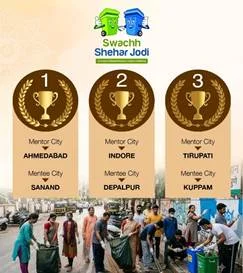
- Indore’s eight-year run ends: The city, which had dominated the previous cleanliness rankings, featured among the leading mentor cities in the Swachh Shehar Jodi category with Depalpur.
- Survey expands its reach: A total of 4,751 urban local bodies were assessed across 176 sub-indicators grouped into 10 sections, with more than 3,000 field assessors deployed.
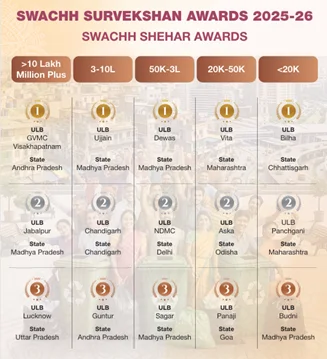
- New environmental categories introduced: Rewa, Puri and Rudrapur were recognised as leading riverfront, coastal and Himalayan cities, respectively.
- Smaller cities record progress: More than 1,700 urban local bodies with populations below 50,000 improved their rankings, while over 350 moved up by more than 500 positions.
- Citizen participation remains significant: Around 2.70 crore citizens provided feedback, reinforcing the role of public participation in assessing urban cleanliness.
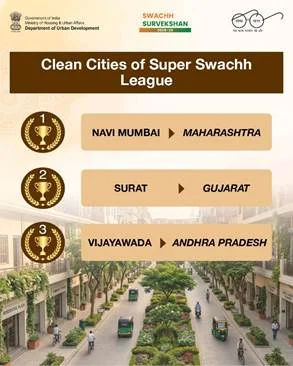
A long-standing chapter in India’s urban cleanliness rankings has come to an end. Indore, which had held the country's cleanest-city position for eight consecutive years, has been displaced by Navi Mumbai in the Swachh Survekshan 2025–26 results. Surat and Vijayawada secured the second and third positions, respectively, in the Super Swachh League.
The awards were presented by President Droupadi Murmu at a ceremony held at Vigyan Bhawan, New Delhi, on November 11, 2026. Organised by the Ministry of Housing and Urban Affairs (MoHUA), the 10th edition of the annual cleanliness assessment recognised urban local bodies across the country for their performance in sanitation, waste management and public participation.
The change at the top is significant, but the latest results also reflect a wider shift in the survey's approach. More cities have been brought into the assessment, separate recognition has been introduced for environmentally sensitive locations, and greater emphasis has been placed on cooperation between better-performing and struggling urban bodies.
The central question now is whether the achievement reflected in the rankings can be sustained through everyday municipal services.
Navi Mumbai Ends Indore’s Long-Standing Dominance
Navi Mumbai Municipal Corporation (NMMC) emerged as the leading performer in the Super Swachh League, moving up from its third position in the previous edition. Surat retained a strong position, finishing second, while Vijayawada secured third place.
For Indore, the result marks a major change after years of dominance. The city had become a national reference point for urban cleanliness, with its performance frequently associated with door-to-door waste collection, segregation, public participation and municipal enforcement.
However, Indore's recognition has not disappeared from the latest awards. It was placed among the leading mentor cities in the Swachh Shehar Jodi category, along with its partner town, Depalpur. The category rewards cooperation between cities and the sharing of successful sanitation practices.
The distinction is important. The Super Swachh League and Swachh Shehar Jodi are separate award categories. Indore's performance as a mentor city should therefore not be confused with its position in the clean-city ranking.
Navi Mumbai's achievement reflects the growing competition among urban administrations. The result also demonstrates that a leading position cannot be treated as permanent. Municipal bodies are required to maintain standards and improve their systems as the assessment framework evolves.
What Makes Navi Mumbai’s Achievement Significant?
Navi Mumbai's rise from third place to the top position in the Super Swachh League has brought its municipal sanitation practices into national focus.
The city's cleanliness efforts have been associated with stricter enforcement of solid waste management rules, regular cleaning of roads and public spaces, citizen feedback through digital platforms such as the Swachhata App and targeted sanitation in high-footfall areas.
The role of the Navi Mumbai Municipal Corporation has been central to coordinating these activities. At the same time, the achievement has been credited to sanitation workers, civic employees, elected representatives and residents who contribute to maintaining public spaces.
However, a ranking alone cannot provide a complete picture of urban cleanliness. The effectiveness of waste segregation, the quality of processing facilities, the condition of public toilets and the treatment of wastewater must also be considered.
The real challenge for Navi Mumbai will be to ensure that its latest recognition is supported by consistent service delivery across residential areas, markets, public spaces and less-visible parts of the city.
A New Structure for India’s Cleanliness Awards
Swachh Survekshan was launched in 2016 with the objective of encouraging competition among urban local bodies and improving sanitation services. What began as an assessment covering 73 cities has expanded considerably.
The 2025–26 edition, marking the survey's 10th year, assessed 4,751 urban local bodies across the country. The evaluation was conducted through 176 sub-indicators grouped into 10 sections. More than 3,000 trained field assessors were deployed for on-ground inspections, supported by GPS-enabled monitoring and digital verification.
The assessment covered several aspects of urban sanitation, including:
- Waste segregation, collection and transportation.
- Solid waste processing and scientific disposal.
- Visible cleanliness in public spaces.
- Access to sanitation facilities.
- Mechanised desludging services.
- Used-water and wastewater management.
- Institutional capacity and sanitation-worker welfare.
- Citizen feedback, public awareness and grievance redressal.
This broader framework is intended to assess more than the visible appearance of a city. It also examines how waste is collected, processed and disposed of, how sanitation services are delivered and whether public complaints are addressed.
The increased coverage has made the survey a significant instrument for comparing municipal performance. However, the results must also be interpreted in the context of differences in population, financial resources, geography and infrastructure among cities.
New Recognition for Riverfront, Coastal and Himalayan Cities
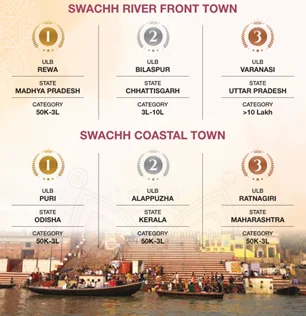
One of the notable additions in Swachh Survekshan 2025–26 was the introduction of dedicated awards for riverfront towns, coastal towns and Himalayan cities.
The new categories recognise the distinct environmental and sanitation challenges faced by these locations.
In the Swachh River Front Town category, Rewa in Madhya Pradesh secured the first position, followed by Bilaspur in Chhattisgarh and Varanasi in Uttar Pradesh.
In the Swachh Coastal Town category, Puri in Odisha was ranked first, followed by Alappuzha in Kerala and Ratnagiri in Maharashtra.
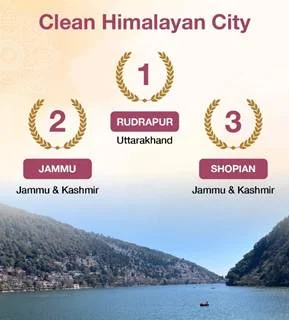
Among Himalayan cities, Rudrapur in Uttarakhand secured the leading position, followed by Jammu and Shopian in Jammu and Kashmir.
The inclusion of these categories is important because conventional urban cleanliness assessments may not fully capture the environmental pressures faced by such locations.
Riverfront towns must address sewage discharge, waste dumping and pollution of water bodies. Coastal settlements face additional pressure from tourism, plastic waste and the protection of marine ecosystems. Himalayan towns, meanwhile, often operate under geographical constraints that make waste collection, transportation and processing more difficult.
By recognising these cities separately, the survey has acknowledged that sanitation solutions must be adapted to local environmental conditions.
Smaller Cities Show Improvement
The latest results have also drawn attention to improvements among smaller urban local bodies.
According to the Ministry of Housing and Urban Affairs, more than 1,700 urban local bodies with populations below 50,000 improved their rankings compared with the previous edition. More than 350 urban local bodies moved up by over 500 positions.
This progress is particularly relevant because smaller municipalities frequently face financial and administrative constraints. Limited budgets, inadequate waste-processing facilities, shortages of trained personnel and weak collection networks can affect the quality of sanitation services.
Improvements in their rankings indicate that cleanliness initiatives are reaching beyond major metropolitan areas. However, the ability to maintain these gains will depend on the availability of municipal funds, trained sanitation workers, local waste-processing facilities and effective monitoring.
For smaller towns, the challenge is not simply to improve their position in an annual survey. It is to establish sanitation systems that can function reliably throughout the year.
Swachh Shehar Jodi: Indore’s New Role as a Mentor
The Swachh Shehar Jodi initiative has added a cooperative dimension to the national cleanliness programme. Instead of relying entirely on competition, the initiative encourages better-performing cities to share their experience with urban local bodies that require improvement.
Under this programme, 70 mentor cities were paired with 191 mentee cities across 33 States and Union Territories. The approach is based on the principle of 'Each One – Teach One', under which successful municipal practices are shared and adapted to local requirements.
The top three city pairs in the 2025–26 results were:
- Ahmedabad–Sanand: First position.
- Indore–Depalpur: Second position.
- Tirupati–Kuppam: Third position.
The awards were based on the combined performance of mentor and mentee cities. The purpose is to recognise not only the cleanliness record of established performers but also their contribution towards improving sanitation in other urban areas.
The Ministry reported improvements among participating mentee cities in several service indicators. Visible cleanliness increased from 48% in the 2024 assessment to 70% in the latest edition. Door-to-door waste collection rose from 52% to 74%, while source segregation improved from 16% to 30%.
The initiative is significant because municipal problems are often practical and location-specific. A city that has developed an effective system for waste segregation, collection or processing can share lessons that may be adapted elsewhere.
Indore's inclusion among the leading mentor cities therefore gives it a different role in this year's awards. Its experience in urban sanitation can continue to influence other municipalities even though it no longer occupies the leading position in the Super Swachh League.
Swachh Bharat Mission-Urban and the Changing Meaning of Cleanliness
Swachh Survekshan is closely linked to the Swachh Bharat Mission-Urban, launched in 2014 to improve sanitation, eliminate open defecation and strengthen urban waste management.
Over time, the mission's focus has expanded beyond toilet construction and basic waste collection. Greater attention has been given to source segregation, waste processing, used-water management, scientific disposal and the remediation of legacy dumpsites.
At the awards ceremony, Union Housing and Urban Affairs Minister Manohar Lal highlighted the expansion of urban waste-processing capacity and door-to-door collection under the mission. He stated that waste processing had increased from 16% in 2014 to 80%, while door-to-door waste collection coverage had risen from 44% to more than 96%.
He also referred to the remediation of legacy dumpsites, through which nearly 11,000 acres of urban land had been made available for productive use.
These figures reflect the scale of progress reported by the government. Yet, the effectiveness of waste management cannot be judged through collection coverage alone.
Waste must be segregated at source, transported without being mixed, processed through appropriate facilities and disposed of scientifically. If collected waste is ultimately dumped without treatment, the environmental benefits of collection are reduced.
Similarly, the remediation of legacy dumpsites requires scientific treatment and continued monitoring to prevent renewed contamination of soil and groundwater.
Sanitation Workers and Citizens Remain at the Centre
Urban cleanliness is often discussed through rankings, infrastructure and municipal performance. However, its everyday implementation depends heavily on sanitation workers and citizens.
Sanitation workers are responsible for essential tasks such as waste collection, street cleaning, drain maintenance and the operation of sanitation facilities. Their work is frequently performed under difficult and potentially hazardous conditions.
Their safety, dignity and welfare must therefore remain an integral part of urban sanitation policy. Access to protective equipment, mechanised cleaning, health services and social protection should not be treated as secondary concerns.
Citizen participation is equally important. Around 2.70 crore citizens provided feedback during the 2025–26 survey, making public responses an important component of the assessment.
Households are expected to segregate waste, avoid littering and cooperate with municipal collection systems. Businesses and commercial establishments must also ensure responsible waste disposal.
At the awards ceremony, President Droupadi Murmu emphasised that cleanliness requires the participation of citizens, local administrations and sanitation workers. She also highlighted the importance of building awareness among children and young people, including through education on plastic waste management.
Public participation, however, can be sustained only when reliable municipal services are available. Residents are more likely to follow segregation rules when separate collection systems function properly and complaints receive timely attention.
The Real Test Begins After the Rankings
Navi Mumbai's rise and Indore's exit from the top position have given the 2025–26 results a significant news angle. But the larger value of Swachh Survekshan lies in whether the competition produces lasting improvements in urban governance.
Municipal bodies must continue investing in waste-processing facilities, sewage treatment, scientific landfill management and efficient collection networks. Greater attention is also required for plastic pollution, drainage systems and the protection of urban water bodies.
Technology-enabled monitoring can improve accountability, but it cannot replace effective municipal planning or adequate staffing. Similarly, public awareness campaigns must be supported by regular services and enforcement.
The latest survey has recognised cities that have demonstrated progress and introduced new ways to encourage cooperation. The next challenge is to ensure that the achievements are not limited to the assessment period.
A clean city is not defined only by its position in an annual ranking. It is defined by whether waste is collected on time, public toilets are maintained, drains remain functional, sewage is treated and sanitation workers can perform their duties safely.
Navi Mumbai has taken the leading position this year, while Indore's experience continues to be recognised through its mentoring role. The rankings may change from one edition to another, but the larger responsibility remains unchanged: cleanliness must become a dependable feature of everyday urban life.
Share this Perspective
Spread rigorous policy evaluation across your professional networks.