
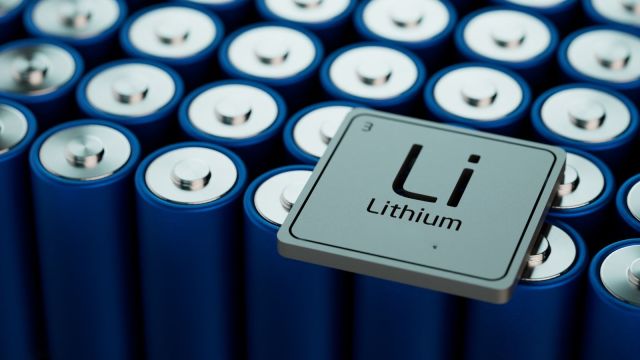
A ₹2,814-crore scheme aims to build domestic lithium and nickel processing capacity and reduce strategic import dependence.
Key highlights
- Cabinet approval: The Union Cabinet approved the Capex Support Scheme to Promote Critical Mineral Processing on 4 November 2026.
- Financial outlay: ₹2,814 crore over five years, from FY 2026–27 to 2030–31.
- Capital subsidy: Government support of 30% of eligible investment.
- Four processing plants: Two lithium plants, each with a minimum capacity of 30,000 tonnes, and two nickel plants, each with a minimum capacity of 50,000 tonnes.
- Target sectors: Electric vehicles, battery energy storage systems, electronics, defence and speciality steel.
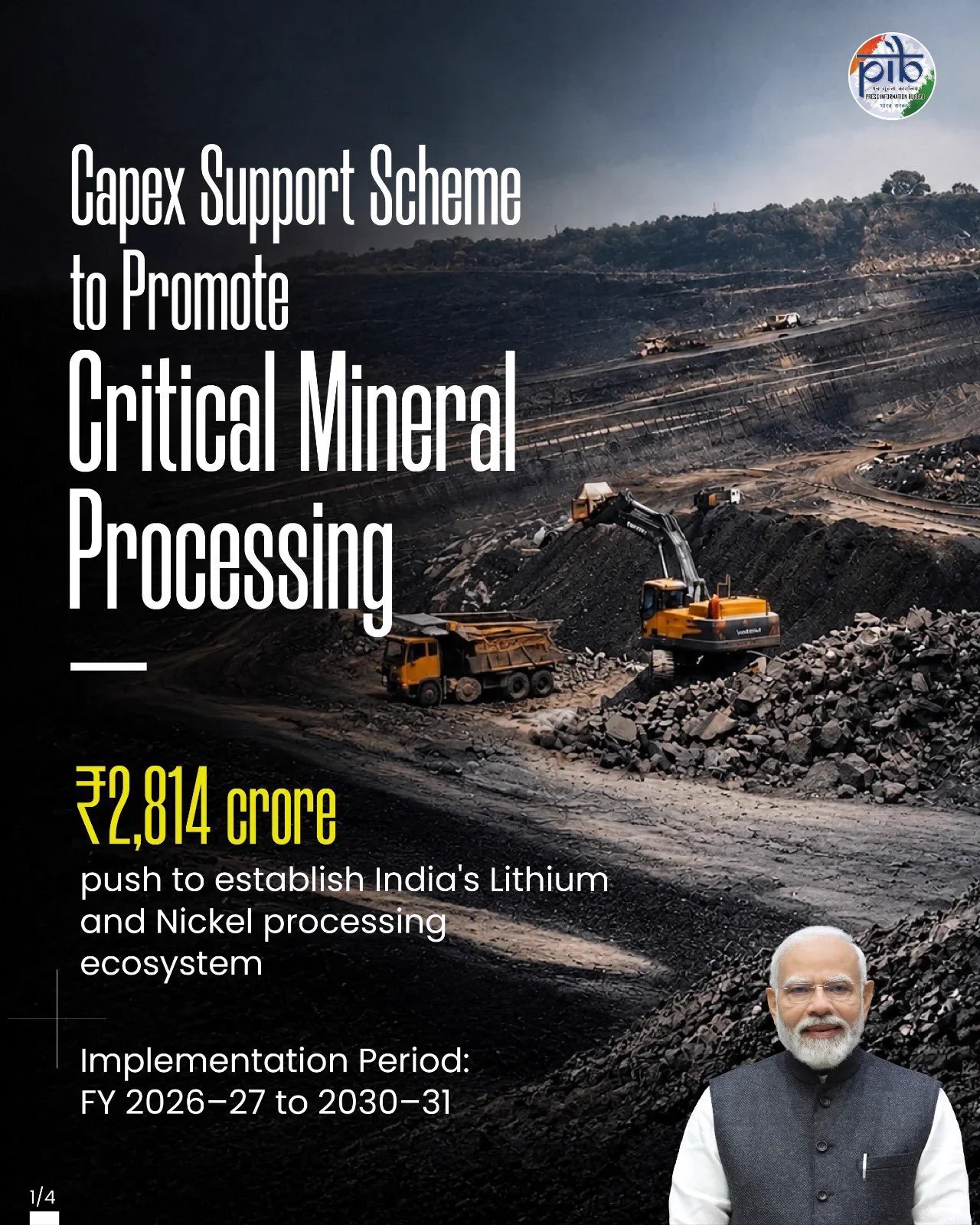
Building India's Critical Mineral Capacity
India's transition towards electric mobility, renewable energy and advanced manufacturing depends on materials that are not always visible to consumers but are essential to everyday technology. Lithium helps power electric vehicle batteries and smartphones.
Nickel improves battery performance and is also important for stainless steel and other industrial applications. Cobalt is used in several battery chemistries and specialised industrial products.
Yet, having access to these minerals is only one part of the challenge. A country must also possess the technology, infrastructure and industrial capacity to convert raw minerals into high-purity materials that manufacturers can actually use.
Recognising this gap, the Union Cabinet on November 4, 2026, approved the Capex Support Scheme to Promote Critical Mineral Processing, with a financial outlay of ₹2,814 crore over five years.
The initiative aims to strengthen India's domestic processing ecosystem for lithium and nickel, reduce dependence on imported refined materials and improve the resilience of critical supply chains.
The announcement is significant not merely because of the financial assistance involved, but because it directs attention towards a relatively less visible part of the critical-minerals industry processing.
Why critical minerals matter?
Critical minerals are materials considered essential for important economic and strategic sectors, particularly where supply is vulnerable to disruption.
Their importance has grown with the expansion of electric vehicles, renewable energy, electronics, telecommunications, defence equipment and advanced manufacturing.
Lithium, nickel and cobalt are particularly important in the battery ecosystem. Lithium is a key component of lithium-ion batteries, while nickel is used in several battery chemistries to improve energy density. Cobalt is also used in certain battery types, although manufacturers are increasingly exploring alternative chemistries to reduce their dependence on it.
Their importance extends beyond electric vehicles. These minerals and their processed compounds have applications in energy storage, electronics, speciality steel, chemicals and defence-related industries.
The problem is that access to mineral resources does not automatically translate into industrial strength. Extracted ores often require several stages of beneficiation, chemical processing and refining before they become suitable for industrial use.
India has made efforts to secure access to critical mineral resources, but domestic processing infrastructure remains at an early stage. Consequently, the country continues to depend substantially on imports of refined intermediates and high-purity materials.
This creates a strategic vulnerability. Disruptions caused by geopolitical tensions, export restrictions, trade disputes or sudden price movements can affect industries that depend on a steady supply of these materials.
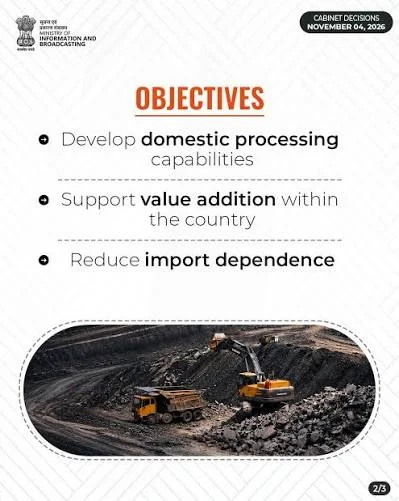
Understanding the ₹2,814-crore scheme
The newly approved scheme seeks to address this gap by providing capital expenditure support to companies willing to establish and operationalise critical mineral processing facilities in India.
Under the scheme, the government will provide a capital subsidy of 30 per cent of eligible investment. The support will be directed towards setting up four processing plants:
- Two lithium processing plants, each with a minimum capacity of 30,000 tonnes.
- Two nickel processing plants, each with a minimum capacity of 50,000 tonnes.
The maximum government assistance has been capped at ₹500 crore for each lithium beneficiary and ₹900 crore for each nickel beneficiary.
The scheme will operate over five financial years, from 2026–27 to 2030–31, with a total allocation of ₹2,814 crore.
The facilities are intended to process lithium and nickel ores or intermediate products into high-purity compounds. Cobalt is also expected to be recovered as a by-product of nickel processing.
An important feature is the proposed selection mechanism. Applicants will first undergo technical qualification. Those who meet the required technical criteria will then participate in financial bidding.
Two beneficiaries for each mineral will be selected on the basis of the least-cost criterion, meaning preference will be given to technically qualified bidders seeking the lowest capital support.
The incentives will be released in three instalments linked to the achievement of specified project milestones. This approach is intended to connect public financial assistance with actual progress in establishing the facilities.
Why processing capacity is as important as mining?
The distinction between mining and processing is central to understanding the government's decision.
Mining involves extracting minerals from the earth.
Processing involves converting the extracted material into usable forms through activities such as beneficiation, chemical treatment and refining.
For example, lithium-bearing ore or an intermediate product cannot simply be used in a battery. It must undergo processing to produce high-purity lithium compounds suitable for industrial applications.
This is where India faces a major challenge. Even when a country has access to mineral resources, the absence of domestic processing facilities can force manufacturers to import refined materials from abroad.
The result is a gap in the value chain. A country may participate in exploration and extraction but lose a significant part of the economic value addition to countries that possess advanced processing infrastructure.
The new scheme attempts to address this imbalance. By supporting domestic processing plants, the government wants to encourage investment in a stage of the supply chain that is essential for battery manufacturing, electronics and other strategic industries.
The challenge is particularly important because critical mineral processing is concentrated in a limited number of countries. China's dominant position in global processing, with its share estimated at around 90 per cent. Such concentration leaves importing economies exposed to external disruptions.
For India, therefore, building domestic processing capacity is not simply an industrial policy objective. It is also a matter of economic security and strategic resilience.
Implications for electric mobility and other industries
One of the most direct beneficiaries of a stronger domestic processing ecosystem could be India's electric mobility sector.
The expansion of electric two-wheelers, passenger vehicles, buses and commercial fleets will increase the importance of reliable battery supply chains.
Battery manufacturers require a consistent supply of processed materials that meet specific quality and performance standards.
Domestic processing could help reduce exposure to international supply disruptions and create stronger links between mineral processing, battery manufacturing and electric vehicle production.
The scheme also has implications for Battery Energy Storage Systems (BESS). As renewable energy capacity expands, storage solutions become increasingly important for managing fluctuations in solar and wind power generation.
Batteries can help store electricity when generation is high and release it when demand rises or renewable output falls.
Electronics is another important sector. Smartphones, computers, communication equipment and several advanced electronic products depend on specialised materials and components.
A more dependable domestic supply chain could support the long-term growth of India's electronics manufacturing ambitions.
The defence sector and speciality steel industry may also benefit from improved access to critical mineral-based materials.
However, the extent of these benefits will depend on the quality, cost and availability of the processed products generated by the new facilities.
A wider push towards mineral security
The capex support scheme should also be viewed in the context of India's broader efforts to strengthen its critical mineral ecosystem.
The National Critical Minerals Mission (NCMM) is intended to address different stages of the value chain, including exploration, mining, processing, recycling and the development of supply-chain capabilities.
The mission also envisages a National Critical Mineral Stockpile Programme to help protect against possible supply disruptions.
Alongside these efforts, the government has been considering the development of critical mineral processing parks in states such as Andhra Pradesh, Gujarat, Odisha and Maharashtra.
These locations offer different advantages in terms of mineral availability, industrial infrastructure and potential processing capabilities. The broader objective is to develop integrated ecosystems rather than isolated industrial facilities.
The new scheme adds a targeted financial incentive to this approach. While mineral exploration and access to overseas resources remain important, the ability to process materials domestically can help India capture a larger share of the value chain.
The challenges India cannot ignore
Despite its potential, the scheme should not be viewed as an immediate solution to India's dependence on imported critical minerals. Establishing processing plants is a complex industrial exercise, and several challenges will determine whether the initiative delivers its intended results.
First, access to raw materials remains essential. Processing facilities require a reliable and commercially viable supply of mineral ores or intermediate products. Without long-term supply arrangements, even well-funded plants may struggle to operate at their intended capacity.
Second, technology and technical expertise matter. Processing lithium and nickel into high-purity compounds requires specialised technologies, skilled personnel and strict quality control. India will need to develop domestic capabilities while also building partnerships that facilitate technology transfer and industrial learning.
Third, environmental sustainability must remain a priority. Mineral processing can involve substantial energy and water requirements, along with chemical waste and other environmental risks. New facilities must follow strong environmental standards, ensure responsible waste management and use resources efficiently. Reducing import dependence should not come at the cost of environmental damage.
Fourth, commercial viability will determine long-term success. Capital subsidies can reduce the initial investment burden, but processing plants must eventually compete on cost, quality and reliability. Their sustainability will depend on market demand, access to technology, operating efficiency and stable supply arrangements.
Finally, the development of processing facilities must be connected with downstream manufacturing. Domestic processing will deliver greater economic benefits when it supports battery manufacturers, electronics producers, electric vehicle companies and other industrial users within India.
These challenges underline why financial assistance alone cannot create a competitive critical mineral industry. Policy coordination, infrastructure, research and development, skilled manpower and private-sector participation will all be necessary.
From import dependence to strategic capability
The ₹2,814-crore capex support scheme represents a focused attempt to strengthen a weak link in India's critical mineral value chain. By encouraging investment in lithium and nickel processing, the government is seeking to move beyond dependence on imported refined materials and build greater domestic value addition.
However, the real measure of success will not be the number of plants announced or the amount of subsidy allocated. It will be whether these facilities become operational, secure reliable raw-material supplies, produce globally competitive materials and create stronger connections with Indian manufacturing.
India's energy transition and industrial ambitions will require more than access to natural resources. They will depend on the ability to convert those resources into reliable, affordable and high-quality industrial inputs.
The new scheme is a step in that direction. Its long-term significance will lie in whether India can turn financial support into technological capability, sustainable industrial growth and a more resilient supply chain.
Share this Perspective
Spread rigorous policy evaluation across your professional networks.