

A new rural employment law promises more guaranteed work and productive village assets, while reshaping funding, planning and Centre-State responsibilities.
Key Highlights
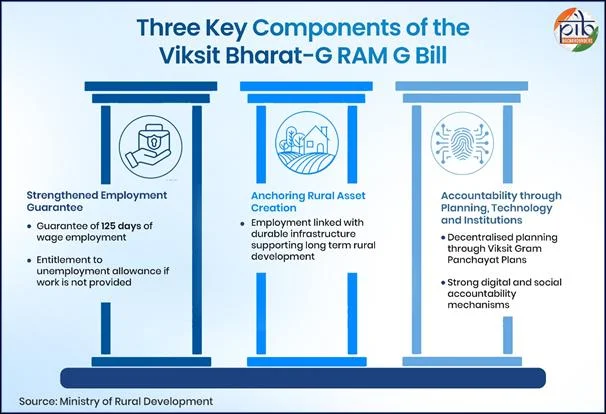
- 125 days of guaranteed work: The statutory entitlement has been raised from 100 to 125 days per rural household in a financial year.
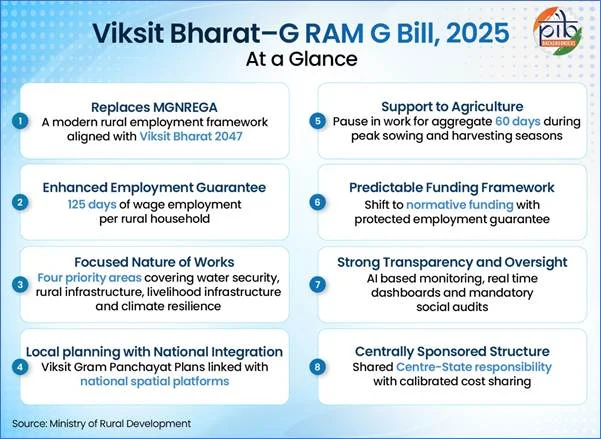
- Four priority areas: Water security, core rural infrastructure, livelihood-related infrastructure and mitigation of extreme weather events have been identified as the main areas for public works.
- A changed funding formula: Most states will share programme costs with the Centre in a 60:40 ratio. A 90:10 arrangement applies to specified North-Eastern and Himalayan states and Union Territories.
- Technology-led monitoring: Biometric authentication, geospatial mapping, mobile dashboards and public disclosures have been included in the accountability framework.
- Employment remains a statutory guarantee: Work is to be provided within 15 days of an application. Unemployment allowance remains payable under the law when work is not provided within the prescribed period.
What Changes Under the VB–G RAM G Act?
A rural worker who asks for employment is not simply looking for a few days of work. For a household dependent on seasonal wages, those days can determine whether food expenses are met, a debt is repaid or a child stays in school.
In villages where agricultural work is uncertain and migration is often the only alternative, the availability of public employment carries a significance that goes well beyond a government scheme.
It was this reality that shaped India's rural employment guarantee under the Mahatma Gandhi National Rural Employment Guarantee Act (MGNREGA), 2005.
Two decades later, the framework has been replaced by a new law: the Viksit Bharat—Guarantee for Rozgar and Ajeevika Mission (Gramin) Act, 2025, popularly known as VB–G RAM G.
The new law promises 125 days of wage employment to every eligible rural household in a financial year, against the earlier guarantee of 100 days. But the change is not limited to an additional 25 days.
The way projects are planned, the manner in which costs are shared between the Centre and states, and the timing of employment during agricultural seasons have also been revised.
The Act came into force across the country on 1 July 2026, and MGNREGA was repealed from the same date. A new chapter in rural employment policy has therefore begun.
Whether it brings greater livelihood security will depend less on the promise written into the law and more on how that promise is delivered in villages.
From MGNREGA to a new rural framework
When MGNREGA was enacted in 2005, it introduced a significant shift in the way rural employment was approached. Work was no longer meant to be provided only at the discretion of local administrations.
A legal guarantee was created, under which eligible rural households could demand unskilled manual work.
The Act was rolled out in phases from February 2006 and eventually covered rural districts across India. At least 100 days of wage employment in a financial year were guaranteed to every rural household whose adult members volunteered to undertake unskilled manual work.
The provision was important for landless labourers, small farmers and families dependent on seasonal agricultural income. Public works were also used to build village roads, conserve water, improve land and create community assets.
The programme's importance became particularly visible during the COVID-19 pandemic. As migrant workers returned to their villages, demand for employment under MGNREGA rose sharply.
For many households, it served as an immediate source of income when work in cities and towns had disappeared.
Yet, the programme was not without difficulties. Delayed wage payments, uneven availability of work, gaps in local planning, administrative shortages and concerns about the quality of assets continued to affect implementation.
In several areas, the statutory 100-day entitlement was not fully realised.
The VB–G RAM G Act has been introduced against this background. Its stated objective is to align rural employment with the national vision of Viksit Bharat @2047, while placing greater emphasis on durable assets, livelihood infrastructure and integrated planning.
The Bill was introduced in the Lok Sabha on 16 December 2025. It was passed by Parliament in December and received presidential assent on 20 December 2025. It became Act No. 36 of 2025.
125 days of work: What has been promised?
The most visible provision is the increase in the employment guarantee from 100 to 125 days per rural household in a financial year.
The distinction between a household and an individual is important. The 125-day entitlement is not available separately to every adult member.
It applies to the household as a whole, whose adult members may volunteer for unskilled manual work.
The law retains the requirement that employment be provided within 15 days of an application.
If work is not provided within that period, the applicant becomes entitled to unemployment allowance, subject to the provisions of the Act and the applicable state scheme.
The unemployment allowance is to be paid by the state government. Under the statutory framework, it must be at least one-fourth of the notified wage rate for the first 30 days and at least one-half of the wage rate for the remaining period, as applicable.
Wage payments are also required to be made weekly or, at the latest, within a fortnight after the work has been done. Compensation is provided for delayed payments under the law.
These provisions matter because an employment guarantee cannot be judged by the number of days printed in a statute alone.
Its value lies in whether a worker can obtain employment when it is sought and receive the payment without unreasonable delay.
Four priorities: Work that leaves something behind
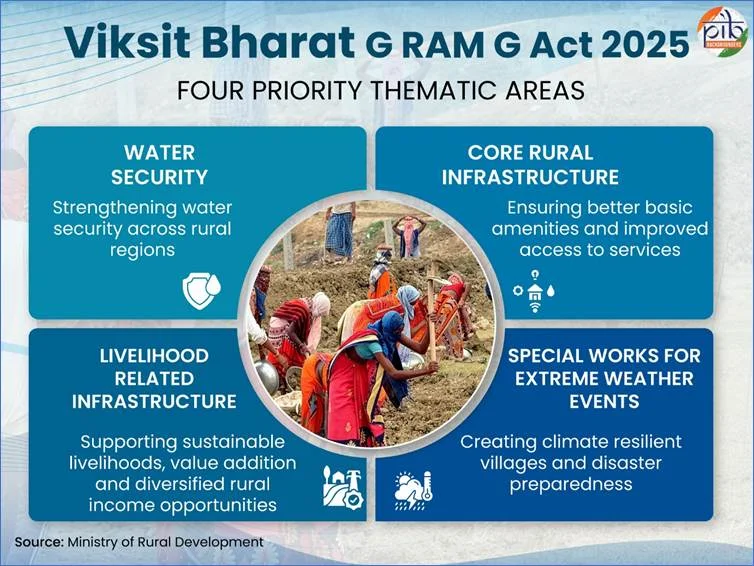
The new law places greater emphasis on the assets created through public employment. Four broad areas have been identified for works under the scheme.
Water security is one of the central priorities. Water conservation structures, restoration of water bodies, groundwater recharge and irrigation-related works are intended to improve the availability of water for rural communities. In regions where agriculture depends heavily on the monsoon, such assets can have benefits long after the work has been completed.
Core rural infrastructure forms the second area. Village connectivity, sanitation-related facilities and essential community infrastructure are among the works that can improve everyday living conditions and access to services.
Livelihood-related infrastructure is the third priority. Assets linked to agriculture, livestock, fisheries and other rural economic activities are intended to support income generation. The objective is to connect wage employment with the productive capacity of rural households.
Mitigation of extreme weather events completes the framework. Floods, droughts, heatwaves and unpredictable rainfall increasingly affect rural livelihoods. Works that improve drainage, conserve natural resources and strengthen local resilience are expected to receive attention.
The shift is significant in its stated direction: public expenditure is expected to generate wages while also creating assets that remain useful to the village. But the quality of those assets will depend on whether projects are selected according to local needs, technically assessed and properly maintained.
Gram Panchayats at the centre of planning
Under the new framework, the Gram Panchayat is expected to play a central role in identifying and planning works.
Projects are to originate from Viksit Gram Panchayat Plans, prepared at the village level after local needs and priorities have been considered.
These plans will be consolidated at the Block, District and State levels before being brought together under the proposed Viksit Bharat National Rural Infrastructure Stack.
The plans are also intended to be integrated with the PM Gati Shakti National Master Plan. Through this arrangement, rural works can be mapped alongside other infrastructure projects, with the stated aim of avoiding duplication and improving coordination between departments.
Consider a village facing repeated water shortages, poor drainage and limited access to agricultural infrastructure. Under an integrated planning approach, these needs could be considered together rather than treated as unrelated projects.
The village's requirements would first be identified locally and then placed within a wider development plan.
At least 50 per cent of the works, measured in terms of cost, are to be implemented through Gram Panchayats.
The approach gives local institutions an important responsibility. It also places a practical demand on them: plans must be prepared, technical estimates must be drawn up, records must be maintained and work must be monitored.
Without trained personnel and administrative support, the promise of bottom-up planning could remain difficult to realise.
The 60-day pause: A difficult balance
One of the most consequential changes concerns the timing of employment.
Under Section 6 of the Act, state governments are required to notify in advance a period aggregating to 60 days in every financial year. The period must cover peak agricultural seasons, particularly sowing and harvesting. During the notified period, works under the scheme are not to be undertaken.
The reasoning is linked to the availability of agricultural labour. Sowing and harvesting are time-sensitive activities, and farmers often require additional workers during these periods. By pausing public works, the government intends to make more labour available for agricultural operations.
However, the provision also raises a question for rural workers. What happens to a household that depends on public employment but cannot find agricultural work during the notified period?
Agricultural labour demand is not uniform across the country. Crop patterns, irrigation facilities, rainfall and local farming practices differ from one region to another. A period suitable for one district may not reflect the agricultural calendar of another.
The Act allows states to issue separate notifications for districts, blocks or Gram Panchayats, taking local agro-climatic conditions and agricultural patterns into account. This flexibility will be important.
The 60-day pause must be planned carefully so that the interests of farmers are considered without leaving vulnerable workers without a realistic source of income.
The financial question: Who pays for the guarantee?
The funding arrangement marks another major departure from MGNREGA.
Under the earlier law, the Union Government bore the full cost of unskilled wages, along with a substantial share of material and administrative expenses. State governments were responsible for specified portions of the material and administrative costs, as well as unemployment allowance and compensation for delayed payments.
VB–G RAM G has been structured as a Centrally Sponsored Scheme. The cost-sharing formula has been revised.
Category | Centre's share | State's share |
Most states and Union Territories with legislatures | 60% | 40% |
North-Eastern and specified Himalayan states and Union Territories | 90% | 10% |
Union Territories without legislatures | 100% | 0% |
The Act also provides for state-wise normative allocations, which are to be determined by the Centre each financial year on the basis of prescribed parameters. Any expenditure incurred by a state beyond its normative allocation will have to be borne by that state.
This provision places greater financial responsibility on state governments. It may encourage more careful budgeting and planning, but it also raises concerns about the ability of states with limited fiscal resources to meet unexpected demand.
Rural employment needs can rise during droughts, floods, crop failures or periods of economic distress. Such circumstances are not always easy to predict while preparing annual allocations.
The question, therefore, is not simply how much money has been allocated, but whether the funding mechanism can respond when rural households need work the most.
Technology and accountability: A stronger monitoring system?
Technology has been given a prominent place in the new framework. Biometric authentication, geospatial mapping, digital monitoring, mobile application-based dashboards and weekly public disclosures have been included as part of the implementation and accountability system.
The proposed arrangements are intended to make employment demand, work allocation, wage payments and project progress easier to track.
Geospatial tools can help identify where assets are being created, while public disclosure can allow villagers to examine muster rolls, sanctions, payments and other records.
Social audits by Gram Sabhas remain important to the accountability framework. They provide a way for workers and local residents to examine whether public funds have been used properly and whether the work recorded on paper has actually been completed.
But technology cannot resolve every administrative problem. Biometric devices may fail, internet connectivity may be weak and workers may face difficulties in completing digital procedures.
If these problems are not addressed, the very systems introduced to improve transparency could make access more difficult for those who need the guarantee.
Digital monitoring must therefore be accompanied by accessible grievance redressal, workable alternatives during technical failures and effective social audits.
What does the 2026–27 allocation tell us?
For the financial year 2026–27, a Central share provision of ₹95,692.31 crore has been made for the scheme at the Budget Estimate stage, according to the Ministry of Rural Development.
With the estimated state contribution, the total programme outlay is expected to exceed ₹1.51 lakh crore.
The allocation is substantial, but the amount alone cannot establish whether the guarantee will be delivered effectively.
The experience under MGNREGA offers an important reminder. A statutory entitlement of 100 days did not mean that every participating household received the full number of days.
Work availability, administrative capacity, fund release and wage-payment systems all influenced the outcome.
The same test will now apply to the 125-day guarantee. The number of households seeking work, the number receiving it, the time taken for payments and the quality of completed assets will offer a clearer picture of implementation than the budget figure by itself.
The questions that will shape implementation
The new law brings opportunities, but several issues will need sustained attention.
Will the funding system respond to demand? Normative allocations may bring greater predictability to budgeting. However, genuine increases in demand during periods of distress must not be allowed to translate into delayed work or unpaid entitlements.
Will states have the capacity to meet their share? The 60:40 formula makes state finances an important part of implementation. Differences in fiscal capacity could affect how smoothly the scheme is delivered across regions.
Will the agricultural pause reflect local realities? The 60-day period needs to be notified according to local crop calendars. Workers should not be left without employment simply because the agricultural season has been treated as uniform across a state.
Will Panchayats receive adequate support? Village-level planning requires technical staff, reliable records and administrative resources. Local bodies must be equipped to carry out the responsibilities assigned to them.
Will digital systems remain accessible? Authentication and monitoring systems should improve transparency without excluding workers who face connectivity or technology-related difficulties.
Will wage payments remain timely? The guarantee will have limited meaning if workers have to wait for wages. Payment delays, grievance resolution and unemployment allowance must be monitored closely.
These are not merely administrative details. They will determine whether the new law is experienced by rural households as a reliable employment guarantee or as a programme whose benefits depend heavily on local capacity.
The road ahead: Employment must remain at the centre
The success of VB–G RAM G will depend on the balance it strikes between two objectives: creating productive rural infrastructure and protecting the income security of workers.
The emphasis on water conservation, village infrastructure and climate resilience reflects real development needs. Rural assets are more valuable when they improve livelihoods, reduce vulnerability and serve communities over time.
Better coordination between departments and stronger Panchayat-level planning could also help public expenditure produce more lasting results.
Yet, an employment guarantee is ultimately judged at the worksite. A household that applies for work needs a clear response. A worker who completes the assigned task needs to be paid on time.
A person who is denied employment within the prescribed period must be able to claim the entitlement provided by law.
States will have to ensure that local plans are realistic, funds are available and grievance mechanisms function.
The Centre, in turn, will need to make allocations and implementation rules responsive to the conditions faced by rural communities.
A rural compact will be judged on delivery
The VB–G RAM G Act, 2025 represents a major change in India's rural employment framework. The guarantee has been raised to 125 days, public works have been linked more closely with village infrastructure, and a new system of financial responsibility and digital monitoring has been introduced.
Its larger promise is that rural employment should contribute not only to immediate income support but also to the long-term development of villages. That is an important ambition. But infrastructure creation and livelihood security cannot be treated as competing goals.
For a rural worker, the measure of the new law will remain simple: whether work is available when it is needed, whether wages arrive on time and whether the assets created improve life in the village.
A developed rural India will require more than roads, water structures and digital dashboards. It will also require secure livelihoods and institutions that respond when people ask for work. The new rural compact will be judged by how well it delivers both.
Share this Perspective
Spread rigorous policy evaluation across your professional networks.