
Key Highlights
- From Advocacy to Action: India is moving beyond calls for dialogue, proposing practical measures to reduce hostilities between Russia and Ukraine.
- Securing the Black Sea: The initiative seeks to protect commercial vessels, civilian crews and critical maritime trade routes.
- Safeguarding Global Food and Energy Security: Maintaining grain and energy exports could protect vulnerable economies from supply disruptions and price volatility.
- Strategic Autonomy in Practice: India's continued engagement with Moscow, Kyiv and Washington demonstrates its ability to maintain diplomatic channels across geopolitical divides.
- A Pragmatic Path to Peace: Rather than attempting to resolve every territorial and political disagreement, India is identifying limited areas of cooperation that could create conditions for broader negotiations.
The Russia-Ukraine war has evolved into more than a territorial and military confrontation between two neighbouring countries. Its consequences have extended far beyond the battlefield, disrupting global energy markets, threatening food security, raising maritime insurance costs and deepening geopolitical divisions. Nearly five years after Russia launched its full-scale invasion of Ukraine in February 2022, the conflict continues to expose the vulnerabilities of an interconnected global economy.
Against this backdrop, India has stepped up its diplomatic engagement, advancing a three-point peace initiative aimed at reducing hostilities and protecting essential economic and civilian infrastructure. Rather than attempting to resolve every political and territorial disagreement between Moscow and Kyiv, New Delhi is focusing on areas where immediate cooperation could produce tangible results.
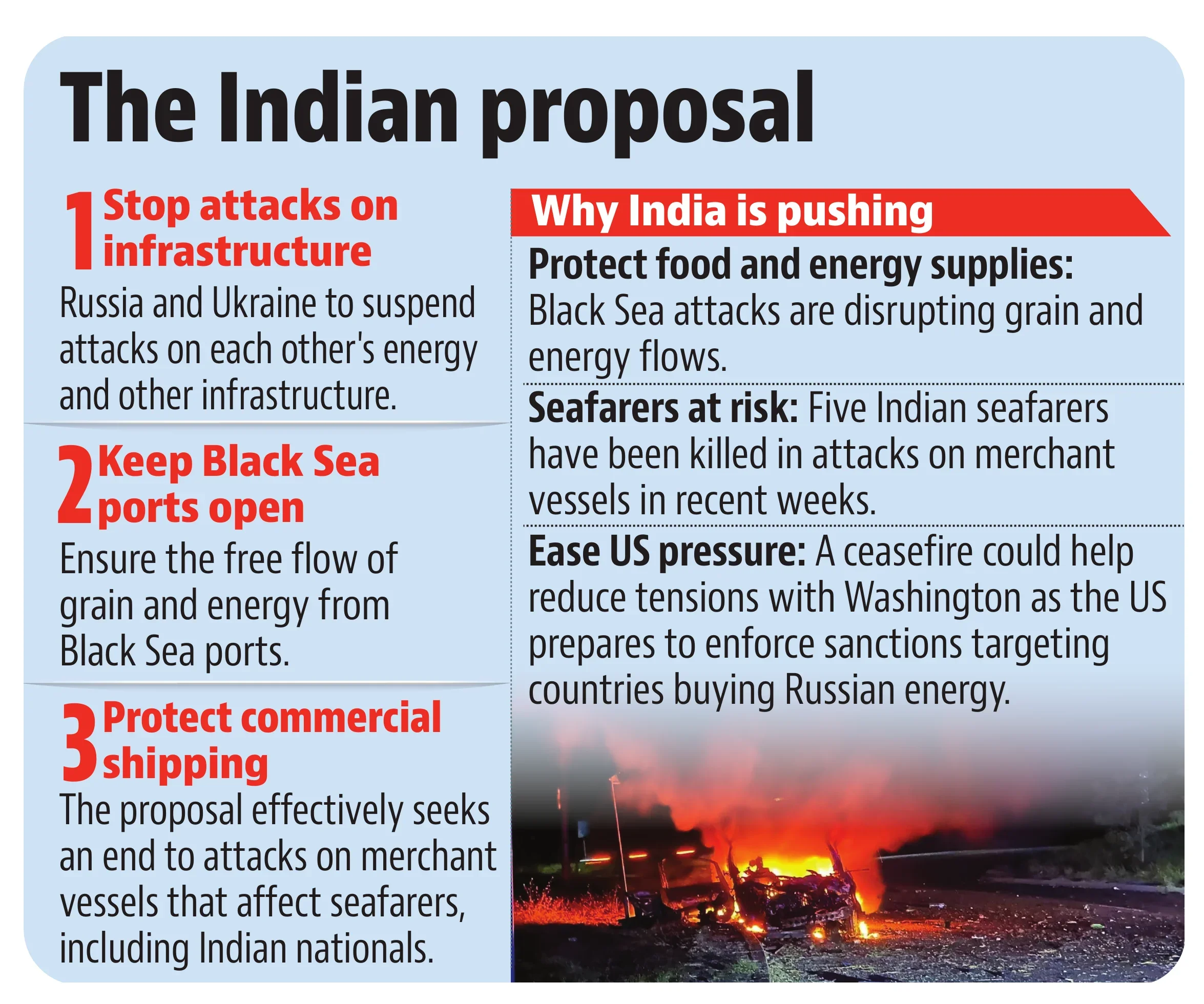
The proposal centres on three interconnected priorities: ensuring the safety of commercial shipping in the Black Sea, maintaining the uninterrupted movement of grain and energy supplies, and exploring non-attack arrangements to protect critical infrastructure and civilian targets.
The significance of this approach lies in its practicality. India is attempting to create limited areas of agreement between two adversaries whose broader political differences remain difficult to reconcile.
From Diplomatic Advocacy to Practical Engagement
India's approach to the Russia-Ukraine conflict has traditionally emphasised dialogue, diplomacy and respect for sovereignty. New Delhi has maintained communication with both Moscow and Kyiv, resisted the pressures of choosing sides and consistently advocated an early end to hostilities.
However, its diplomatic engagement has gradually moved beyond statements and appeals for negotiations.
Prime Minister Narendra Modi's interactions with Russian President Vladimir Putin and Ukrainian President Volodymyr Zelenskyy have provided channels for discussing possible avenues towards de-escalation. External Affairs Minister S. Jaishankar has also held discussions with Ukrainian and Russian leadership on the humanitarian and economic consequences of the war.
During his September 3 visit to Kyiv, Jaishankar discussed the safety of commercial shipping, the consequences of food, fuel and fertiliser shortages, and the wider impact of the conflict on developing economies.
Ukraine subsequently acknowledged receiving proposals from India, Egypt, Turkey and the United States. Ukrainian Foreign Minister Andrii Sybiha described India's proposal as the most comprehensive among the initiatives under consideration, highlighting its coverage of energy infrastructure, ports and Black Sea maritime security.
Russian President Vladimir Putin has also acknowledged Prime Minister Modi's efforts to identify mutually acceptable solutions.
These developments suggest that India's diplomatic engagement is increasingly focused on identifying practical arrangements that both parties could potentially accept.
The Three Pillars of India's Peace Initiative
1. Protecting Commercial Shipping in the Black Sea
The first priority is to prevent attacks on commercial vessels and civilian crews operating in the Black Sea.
The Black Sea is one of the most important maritime corridors connecting Russia and Ukraine to international markets. Its ports and shipping routes facilitate the movement of agricultural commodities, energy resources and other essential goods.
The conflict has repeatedly exposed merchant vessels, port facilities and maritime infrastructure to military attacks. Such disruptions have increased shipping risks, raised insurance and freight costs and affected international commodity markets.
For India, the issue is particularly important because attacks on commercial vessels have also endangered Indian seafarers. The deaths of five Indian sailors in attacks involving merchant vessels in recent weeks have reinforced New Delhi's concerns about the safety of civilian maritime personnel.
A maritime non-attack arrangement could establish a degree of protection for commercial shipping, reduce risks to civilian crews and restore confidence in essential trade routes.
2. Keeping Grain and Energy Supplies Flowing
The second pillar addresses the economic consequences of disruptions to grain and energy exports.
Ukraine remains an important agricultural exporter, with its Black Sea ports serving as critical gateways for wheat, corn and other agricultural commodities. Russia, meanwhile, is a major global supplier of grain and energy resources.
Disruptions to these routes have consequences extending well beyond the two countries. Import-dependent economies across Africa, West Asia and parts of Asia are particularly vulnerable to interruptions in food supplies and fluctuations in commodity prices.
The energy dimension is equally significant for India.
Black Sea ports account for a substantial share of Russian energy shipments to India. Disruptions around important export facilities, including Novorossiysk, have affected supply patterns and contributed to higher freight costs.
For New Delhi, therefore, securing maritime trade is not simply a diplomatic concern. It is directly connected to energy security, inflation management and the stability of domestic economic activity.
The proposal seeks to keep grain and energy shipments moving through Black Sea ports, preventing military hostilities from further disrupting essential commodity flows.
India has also expressed willingness to contribute to establishing food corridors that would allow Ukrainian agricultural exports to reach international markets.
3. Preventing Attacks on Critical Infrastructure and Civilian Targets
The third pillar involves exploring non-attack arrangements covering energy facilities, ports and other critical infrastructure.
Repeated attacks on energy installations have damaged electricity-generation and distribution systems, disrupted industrial activity and affected civilian populations. Similar threats to port infrastructure have complicated the movement of essential commodities.
An agreement to suspend attacks on selected infrastructure could reduce the immediate humanitarian and economic costs of the conflict.
It would also create an opportunity for both sides to demonstrate a willingness to cooperate without requiring them to resolve their larger disagreements over territory, security arrangements or the future political order.
This distinction is important. A limited non-attack agreement may not bring the war to an end, but it could reduce the intensity of economic warfare and establish conditions for more substantive negotiations.
Why the Black Sea Matters to the Global Economy
The Black Sea is not merely a regional maritime space. It is an important component of the global food and energy supply chain.
Ukraine's major deep-water ports, including Odesa, Chornomorsk and Pivdennyi, collectively handle the overwhelming majority of its agricultural exports. Russia also depends heavily on the wider Azov-Black Sea region for exporting grain and other commodities.
Any sustained disruption in this region can therefore affect international food prices, agricultural supply chains and the availability of essential commodities.
For developing countries, the consequences can be particularly severe. Higher food and fuel prices disproportionately affect households with limited purchasing power, while import-dependent economies face pressure on their foreign-exchange reserves and fiscal balances.
This is where India's proposal acquires significance beyond the immediate conflict.
By advocating protected shipping routes and uninterrupted commodity movement, New Delhi is addressing a structural vulnerability in the international economic system: the dependence of global markets on a handful of strategically important maritime corridors.
The initiative also reflects India's broader understanding that geopolitical conflicts cannot be viewed exclusively through the lens of military victories and territorial control. Their economic and humanitarian consequences must also become part of the peace process.
India's Strategic Interests: Energy Security and Economic Stability
India's diplomatic initiative is also shaped by its legitimate national interests.
Russia remains an important source of India's energy imports. Any disruption in Russian crude supplies can influence procurement costs, freight expenses and the country's broader energy-security calculations.
At the same time, India's economic relationship with Western economies makes the continuation of the conflict diplomatically complicated.
Washington's growing pressure over purchases of Russian energy and the possibility of punitive trade measures have added another dimension to India's calculations.
For New Delhi, a reduction in hostilities could help ease some of these pressures while creating a more predictable environment for international trade.
However, India's engagement should not be reduced to an attempt to protect discounted Russian oil supplies or secure short-term economic advantages. The country's dependence on stable maritime trade, affordable energy and international food markets gives it a broader interest in preventing the conflict from destabilising the global economy.
The initiative consequently combines national interest with a wider commitment to economic stability.
Strategic Autonomy as an Instrument of Peace
One of the most important aspects of India's diplomatic approach is its ability to maintain working relationships with competing geopolitical powers.
India has continued its engagement with Russia while strengthening strategic and economic cooperation with the United States and European countries. It has also maintained direct diplomatic communication with Ukraine.
This positioning is often described through the concept of strategic autonomy. However, its significance extends beyond the freedom to make independent foreign-policy decisions.
Strategic autonomy provides India with diplomatic access to multiple sides of an international conflict. It allows New Delhi to communicate with governments that may have limited trust in one another and identify areas where their interests could temporarily converge.
India's approach is therefore different from conventional mediation, which often begins with negotiations over the fundamental causes of a conflict. Instead, it seeks to create practical cooperation around issues that directly affect both parties and the international community.
The safety of merchant vessels, protection of civilian infrastructure and uninterrupted movement of essential commodities offer precisely such an opportunity.
The Limits of India's Initiative
Despite its diplomatic significance, India's proposal faces considerable challenges.
The Russia-Ukraine conflict is rooted in fundamental disagreements over territory, sovereignty, security guarantees and the future European security architecture. Neither the protection of shipping routes nor a temporary suspension of infrastructure attacks can independently resolve these disputes.
The implementation of any maritime or infrastructure arrangement would also require clarity on monitoring mechanisms, geographical coverage, verification procedures and consequences for violations.
Trust remains another major obstacle. Both sides would need assurances that a ceasefire covering commercial shipping or energy infrastructure would not be exploited to secure military advantages.
Furthermore, the willingness of the two governments to accept limited arrangements does not necessarily translate into agreement on a comprehensive political settlement.
India's initiative should therefore be understood as a conflict-management framework rather than a complete peace agreement.
Its immediate objective is to reduce the costs of war, protect civilian lives and create conditions in which broader diplomatic engagement becomes possible.
A Larger Role for India in Global Conflict Resolution
India's three-point peace initiative reflects an evolving understanding of its responsibilities in an increasingly fragmented international order.
As one of the world's major economies and an influential voice of the Global South, India has a direct stake in maintaining the stability of international trade, energy markets and food supply chains.
The initiative also demonstrates that diplomatic influence does not necessarily depend on military intervention or the ability to impose a settlement. It can emerge from maintaining communication, understanding the economic interests of competing parties and identifying practical areas of cooperation.
For India, the challenge will be to translate diplomatic acceptance into verifiable commitments from Moscow and Kyiv.
A functioning Black Sea shipping arrangement, protected food corridors and non-attack commitments for critical infrastructure would represent meaningful progress, even without an immediate political settlement.
Ultimately, the success of India's initiative will depend not on how comprehensive its proposal appears on paper, but on whether it can help convert diplomatic conversations into arrangements that reduce human suffering and restore confidence in global trade.
In a world increasingly shaped by geopolitical confrontation, India's approach offers an important proposition: peace need not begin with agreement on everything; sometimes, it begins with an agreement to stop destroying what the world depends on.
Share this Perspective
Spread rigorous policy evaluation across your professional networks.