

India's first SCO Civilisational Dialogue Forum has placed heritage at the centre of debates over identity, diplomacy and global power.
Key Highlights
- India hosted the first SCO Civilisational Dialogue Forum at Purana Qila, New Delhi, from November 20 to 22, 2026.
- The initiative aims to complement the SCO’s existing cooperation in security, economy and connectivity with cultural and civilisational engagement.
- The idea of a civilisational state places a country’s historical memory, cultural traditions and philosophical inheritance alongside its modern political identity.
- China, Russia, India and other countries increasingly draw on civilisational narratives to explain their global role and foreign policy choices.
- The Indraprastha Communiqué called for cooperation in heritage conservation, manuscript digitisation, joint research, cultural exchanges and the use of technology, including AI.
- Civilisational diplomacy can build trust, but it cannot replace political dialogue, resolve territorial disputes or override the sovereignty of other states.
History Returns to the Diplomatic Table
When world leaders discuss international relations, the conversation is usually shaped by security, trade, technology, military alliances and economic interests. But history and culture are increasingly being brought into the same diplomatic space.
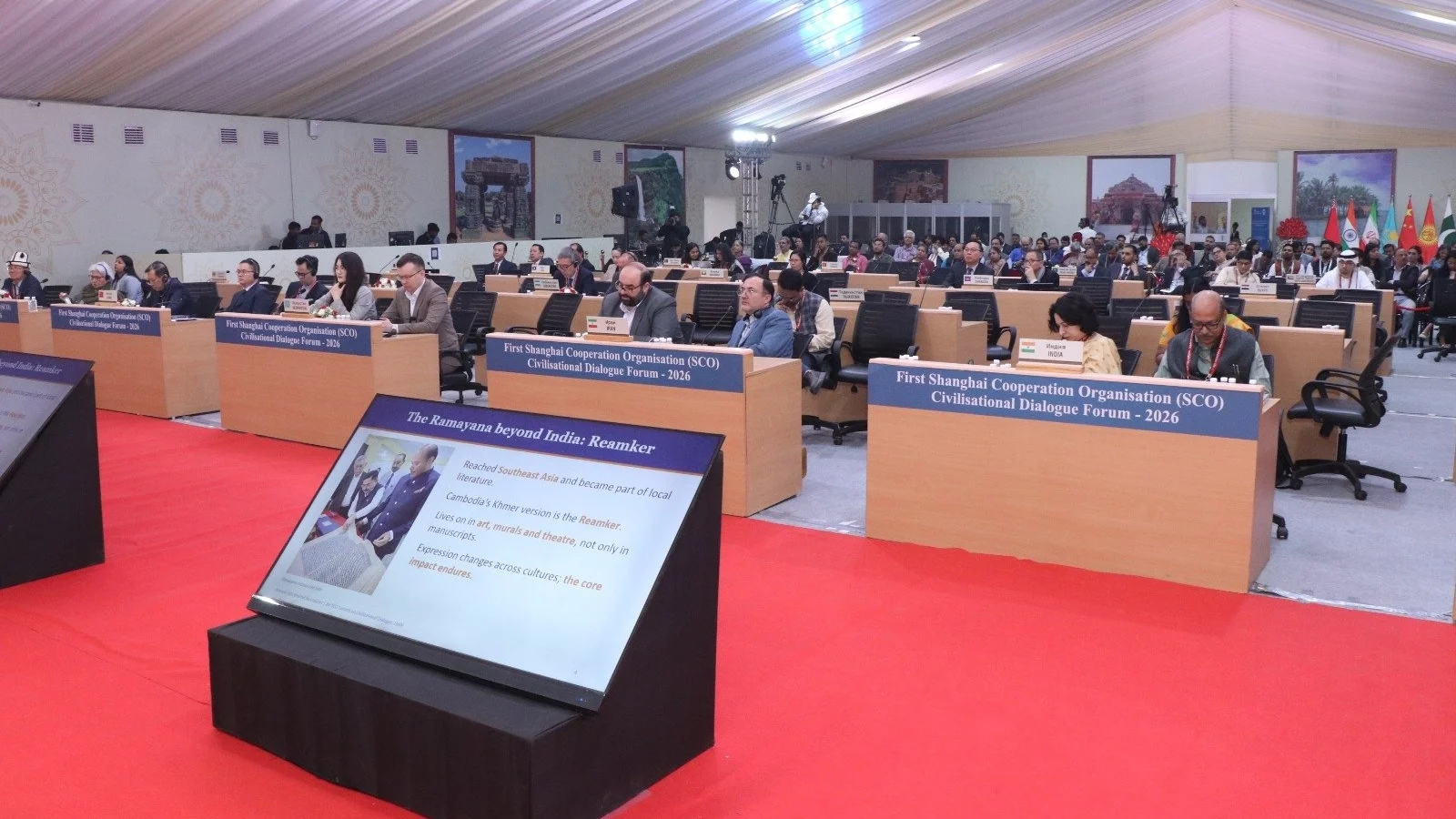
The first Shanghai Cooperation Organisation (SCO) Civilisational Dialogue Forum, held in New Delhi from November 20 to 22, 2026, reflected this growing emphasis. Inaugurated by Prime Minister Narendra Modi at Purana Qila, the three-day forum was designed to explore the shared cultural and historical connections among SCO countries and strengthen people-to-people ties.
The gathering brought together 116 delegates from 22 countries, including ministers, diplomats, scholars, cultural representatives and experts. It was organised by India’s Ministry of Culture and Ministry of External Affairs, with the Indira Gandhi National Centre for the Arts serving as the knowledge partner.
The forum was not intended to replace the SCO’s established agenda. Instead, it sought to add a cultural dimension to an organisation whose cooperation has largely focused on security, economic relations and connectivity.
The event also reflected a wider trend in global politics: countries are increasingly using their historical experience and cultural identity to explain how they see the world and what kind of international order they want.
What Is a Civilisational State?
A civilisational state is generally understood as a modern sovereign state whose identity is linked to a much longer historical and cultural inheritance.
Its national story is not confined to the period when its present borders or political institutions were established. It draws on centuries—or, in some cases, millennia—of shared memories, languages, religious and philosophical traditions, artistic practices and intellectual exchanges.
The concept is often discussed in relation to countries such as China, India and Russia. However, it is not a formal category of statehood under international law. It is a political and intellectual framework through which a country interprets its identity and international role.
A conventional nation-state is commonly described through its territory, population, citizenship, sovereignty and institutions. A civilisational narrative adds another layer: the idea that a country’s present-day identity has been shaped by a continuous and evolving historical experience.
This distinction does not mean that civilisational states lack modern institutions or that nation-states have no cultural history. Most countries draw on both. The difference lies in the emphasis placed on civilisational continuity when national identity and foreign policy are explained.
The idea has gained attention because many countries believe that the modern international system does not fully reflect their historical experiences or political aspirations.
Why Civilisational Identity Is Gaining Importance?
The global order is undergoing a period of change. Strategic competition among major powers, regional conflicts, economic uncertainty, and concerns about the effectiveness of multilateral institutions have encouraged countries to rethink how they position themselves internationally.
For several emerging and established powers, civilisational identity offers a way to challenge the assumption that one political or developmental model should be treated as universal.
It also provides a language for strategic autonomy. Countries can maintain relations with competing powers while presenting their foreign policy as rooted in their own historical experience and national priorities.
Civilisational diplomacy, therefore, is not simply about celebrating ancient monuments or cultural festivals. It can also be used to shape a country’s image, build partnerships and strengthen its influence in regions connected through history, religion, language or trade.
However, it should not be confused with a rejection of modern international institutions. In practice, countries that invoke civilisational identity continue to engage through diplomacy, treaties, trade agreements and multilateral organisations.
China, Russia and India: Different Civilisational Narratives
China has increasingly presented its development as a path shaped by its own historical experience rather than a model that must follow Western political or economic trajectories. Its civilisational narrative is linked to historical continuity, cultural confidence and the argument that modernisation can take different forms.
Russia’s official foreign policy framework has described the country as a distinct state-civilisation with Eurasian and Euro-Pacific connections. This identity is used to support its emphasis on multipolarity and engagement with countries beyond the West. At the same time, Russia’s claims to a wider historical and cultural space remain contested, particularly where they intersect with the sovereignty and national identity of neighbouring states.
India’s civilisational narrative draws on a diverse history of philosophical traditions, languages, religions, art, knowledge systems and cultural exchanges. Its international engagement has included Buddhist diplomacy, the promotion of yoga, heritage links with Southeast Asia and Central Asia, and the use of the principle of Vasudhaiva Kutumbakam—the world is one family.
These approaches are not identical. Each country uses history in ways shaped by its own political system, strategic interests and understanding of national identity.
The broader trend is that civilisational language has become a part of contemporary foreign policy—not as a substitute for national interest, but as a way of explaining and presenting it.
The SCO Forum: From Shared Heritage to Contemporary Cooperation
The SCO Civilisational Dialogue Forum was proposed by India at the organisation’s summit in Tianjin in 2025. The proposal was subsequently welcomed in the Bishkek Declaration.
The inaugural forum was held at Purana Qila, a historic site in Delhi, and included cultural presentations, exhibitions and thematic discussions on the region’s interconnected heritage.
The deliberations examined historical exchanges across Central Asia, China, India and the wider Eurasian region. These connections were reflected in trade routes, the movement of scholars and religious teachers, the spread of Buddhist thought, and the exchange of artistic and architectural traditions.
The forum also explored how cultural cooperation could be taken forward through practical initiatives. These included joint research, exhibitions, academic exchanges, manuscript preservation, heritage tourism and collaboration among museums, libraries and universities.
The Indraprastha Communiqué, prepared at the conclusion of the forum, recognised cultural heritage as a bridge of friendship and good-neighbourliness. It called for respect for every civilisation, recognition of diversity, protection of heritage and stronger people-to-people ties.
The communiqué also proposed cooperation on joint UNESCO heritage nominations, the digitisation and translation of manuscripts, the creation of a digital repository and the constructive use of artificial intelligence in cultural preservation. India proposed that the dialogue forum meet every two years, with the venue to be decided by SCO member states.
These proposals indicate that civilisational dialogue is being presented not only as a symbolic exercise but also as an area for institutional cooperation.
From the Silk Routes to Digital Archives
The history of Eurasia offers several examples of how civilisations have influenced one another.
Trade routes connected merchants, travellers, scholars and religious communities across vast distances. Along these routes, goods were exchanged, but so were ideas, languages, artistic styles and systems of knowledge.
Buddhist philosophy travelled from India through Central Asia into China and other parts of East Asia. Scholars came to India to study at centres of learning such as Nalanda, while texts and ideas were translated and adapted in different cultural settings.
Literature also crossed boundaries. The stories of the Panchatantra travelled through Persian and Arabic traditions, while versions of the Ramayana developed in Southeast Asia, including Cambodia, where it became part of local literature and performing arts.
Mathematics, architecture, music and spiritual traditions were similarly shaped by contact among different societies.
These historical exchanges challenge the idea that civilisations developed in complete isolation. They show that cultural identity was often formed through interaction, adaptation and the movement of people.
The SCO forum sought to connect this history with present-day opportunities. Digitising manuscripts, translating texts, creating shared archives and supporting research collaborations could make cultural resources more accessible to younger generations.
Technology, including AI-assisted translation, may help overcome language barriers. However, such tools must be used carefully, with attention to accuracy, context and the rights of the communities and institutions that preserve cultural material.
Can Civilisational Diplomacy Bridge Geopolitical Divides?
The appeal of civilisational diplomacy lies in its ability to create channels of engagement beyond formal political alliances.
Cultural exchanges can bring scholars, artists, students and communities into contact even when governments disagree on strategic matters. Shared heritage may provide a starting point for dialogue where political trust is limited.
Yet the limits are equally important.
A shared cultural past does not automatically produce political cooperation. India and China, for example, have deep historical and Buddhist connections, but these have not removed strategic competition or border tensions.
Civilisational narratives can also become divisive when history is selectively interpreted to claim superiority, justify territorial ambitions or diminish the independent identity of neighbouring societies.
The risk is that culture, which can serve as a bridge, may be turned into a political boundary between those considered part of a civilisation and those placed outside it.
For this reason, civilisational diplomacy must be based on mutual respect rather than cultural hierarchy. The recognition of shared heritage should not mean that different countries are expected to surrender their distinct identities or political choices.
The Indraprastha Communiqué’s emphasis on equality, consultation, diversity and respect for every civilisation is important in this context. These principles will matter more in practice than ceremonial declarations.
A New Layer of Global Politics
The growing use of civilisational identity reflects a broader change in how countries seek recognition and influence in international affairs.
As the world becomes more multipolar, historical memory and cultural confidence are being used alongside economic strength, military capability and technological progress. For countries such as India, this offers an opportunity to build partnerships through cultural connections while continuing to pursue strategic autonomy.
But civilisational identity is most useful when it remains open and inclusive. It should help explain a country’s experience without being used to claim that its history is superior to others.
The SCO Civilisational Dialogue Forum has created a platform for this conversation. Its long-term value will depend on whether the ideas discussed in New Delhi are translated into sustained cultural cooperation, research, heritage protection and exchanges among people.
In a world increasingly divided by strategic competition, history may not resolve every conflict. But when it is approached with openness and respect, it can help countries understand one another beyond the immediate calculations of power.
The challenge is not to establish which civilisation should lead the world. It is to ensure that different civilisational traditions can coexist, contribute, and cooperate within a shared international system.
Share this Perspective
Spread rigorous policy evaluation across your professional networks.